
Product
FRIENDLY/link Nantong zhuolida Ali SAMSAN Corrosion machining Nantong zhuolida HJD Shenzhen zhuolida Esprit print
HOTLINE
189-3869-3452 0513-8160 1666


189-3869-3452 0513-8160 1666

To etch the strainer refers to the manufacturing process of making metal filter strainers through chemical etching technology. This conventional subtractive processing method corrodes regular micropores and mesh structures on integral metal sheets via specific chemical solutions. Etched strainers are common precision filter components widely used in general industrial filtration, fluid purification, and impurity removal scenarios. It features flat surface and no mechanical deformation, since no physical cutting or stamping force is applied to the raw metal material during production.
Chemical etching can produce strainers with diverse hole patterns, including round holes, square holes and slotted holes. Manufacturers can adjust aperture size and open area ratio according to basic filtration requirements. Nevertheless, the process has inherent limitations when it comes to ultra-fine pores and high aspect ratio structures, restricting its application in high-end precision filtration fields.
The whole workflow to etchthe strainer includes raw material cleaning, photoresist coating, exposure, development, chemical etching and post-treatment. Unlike laser cutting or stamping, etching removes metal by chemical dissolution, leaving no burrs or metal scraps around the holes. Pore size across a single workpiece stays relatively consistent when processing medium and large apertures. There is no need for expensive hard tooling for production, and pattern modification only requires updating the photomask, which shortens sample lead time for small-batch orders.
However, etching depth is limited and difficult to control precisely for thin and ultra-fine mesh. Side etching inevitably takes place during chemical reaction, which enlarges the actual hole size and reduces wall thickness. The thinner the metal sheet, the more obvious this side corrosion effect will be.
When manufacturers etch the strainer, a set of typical defects may emerge and compromise filtering performance. Lateral corrosion tends to widen micropores and leads to unstable filtration accuracy, allowing fine particles to pass through the mesh unexpectedly. Residual photoresist or chemical sediment may remain inside tiny holes after processing, resulting in partial blockage and uneven fluid flow.
The chemically corroded hole wall lacks sufficient smoothness, which easily traps impurities and triggers early clogging under continuous operating conditions. The process also meets a bottleneck in producing ultra-micro pores. The production yield will drop sharply once extremely thin metal ribs are required. These defects are tolerable for ordinary industrial filtration, yet fail to satisfy strict standards in semiconductor, new energy and precision fluid control industries.
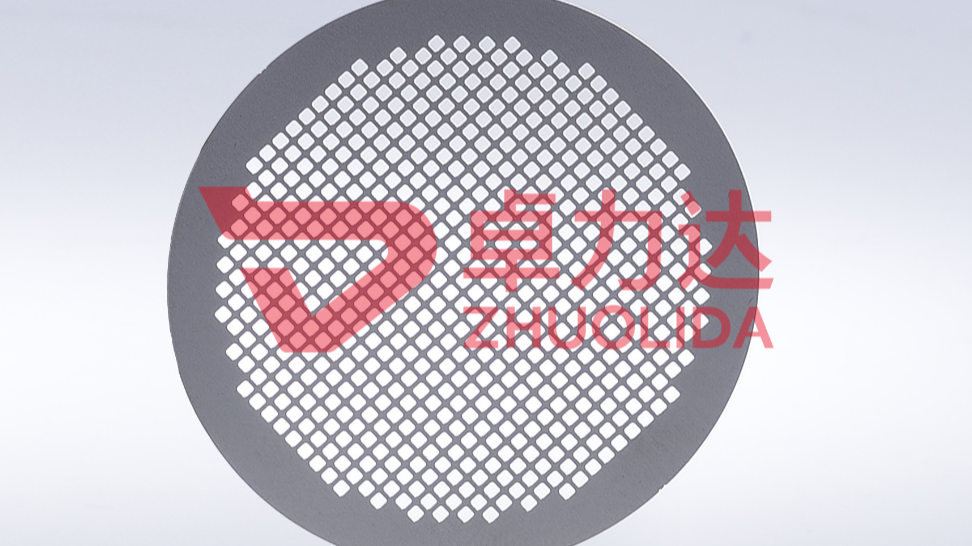
For scenarios requiring ultra-fine, highly uniform filter strainers, electroforming serves as an ideal alternative to etching. Different from the subtractive method used to etch the strainer, electroforming is an additive manufacturing technology that deposits metal ions onto the conductive mould surface to form mesh structures.
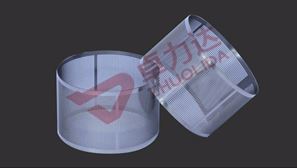
Electroformed strainers deliver ultra-consistent aperture, smooth hole inner walls and controllable ultra-fine metal ribs with no side etching problem. Products made by Nantong Zhuolida can realize micron-level pore size, stable filtering precision and excellent flatness, which perfectly fits high-end filtration, liquid purification and gas separation requirements.
Compared with etched strainers, electroformed mesh boasts higher dimensional repeatability in mass production, longer service life and better resistance to pressure fluctuation. Although the cost is relatively higher, it greatly reduces the risk of product failure and maintenance frequency for precision equipment.
etchd strainers fit conventional filtration projects with medium precision demand, large aperture and low budget, covering applications such as general liquid impurity filtering and coarse particle separation.
Electroformed strainers are recommended for projects demanding micron ultra-fine pores, strict tolerance control and stable long-term filtration performance. They are widely adopted in semiconductor equipment, new energy battery fluid systems and precision medical devices.
To etchthe strainer is a mature, cost-effective manufacturing route for standard metal filter mesh. But its inherent side etching and precision bottleneck make it unsuitable for high-precision working conditions. When ultra-stable filtration accuracy is required, electroformed strainers from professional manufacturers become the preferred solution, breaking through the precision limitation of traditional etching processing.

 189-3869-3452 0513-8160 1666
 E-MAIL:yw5@zldsmt.com
 QQ:$qq
 No. 268, Jinchuan Road, Nantong high tech Industrial Development Zone, Tongzhou District, Nantong City, Jiangsu Province
All Rights Reserved © 2019-2030Nantong Zhuolida metal Technology Co., Ltd.
ICP:【苏ICP备17060045号-3】


 TEL
TEL Products
 News
News About us