
Product
FRIENDLY/link Nantong zhuolida Ali SAMSAN Corrosion machining Nantong zhuolida HJD Shenzhen zhuolida Esprit print
HOTLINE
189-3869-3452 0513-8160 1666


189-3869-3452 0513-8160 1666

Etch the horn mesh is a common manufacturing technique used to produce precision horn-shaped metal mesh for acoustic devices, dustproof equipment and industrial ventilation components. Manufacturers etch the horn mesh through professional chemical etching processes to create uniform micro holes and complete horn outline on integral metal sheets. As a cost-effective processing method, etch the horn mesh is widely used for mass production of standard horn mesh parts. Compared with woven mesh, the etched horn mesh features flat surface, regular hole arrangement and no mechanical deformation, which is suitable for most ordinary industrial horn assembly scenarios.
The whole workflow to etch the horn mesh belongs to subtractive photochemical machining. The production process includes metal surface cleaning, photoresist coating, pattern exposure, development, chemical etching and final surface treatment. When factories etch the horn mesh, the preset horn shape and mesh aperture are defined by photomask patterns. The exposed metal area is dissolved by etching liquid, while the protected area remains intact to form a complete mesh structure. This processing method allows flexible adjustment of mesh density and horn size, making etched horn mesh highly customizable for conventional industrial needs.
There are obvious practical advantages when manufacturersetch the horn meshfor general industrial applications. The etching process requires no expensive stamping molds, greatly reducing the production cost and sample development cycle. The etched horn mesh has no burrs or sharp edges after processing, ensuring safe installation and stable equipment operation. In medium and low-precision scenarios, to etch the horn mesh can achieve stable batch consistency, meeting the mass production demands of ordinary speakers, ventilation horns and dustproof accessories. Its flexible customization capability also supports small-batch personalized horn mesh production.
Despite its mature application, to etch the horn mesh has unavoidable technical limitations that restrict its use in high-end equipment. The biggest problem is lateral side etching during chemical reaction. When workers etch the horn mesh, the etching solution corrodes the metal vertically and horizontally, forming tapered hole walls with inconsistent upper and lower aperture sizes. The inner wall of etched horn mesh is rough and uneven, which easily accumulates dust and impurities during operation, resulting in blocked holes and reduced acoustic permeability. Long-term vibration and ventilation will also cause slight deformation of etched mesh, affecting the overall stability of horn equipment.
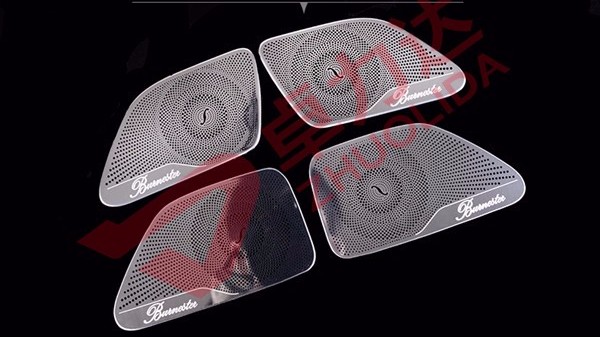
The structural defects brought by the process to etch the horn mesh also lead to poor durability. Chemical corrosion will damage the compact metal structure, making etched horn mesh prone to oxidation and rust in humid and dusty environments. For high-end acoustic equipment, precision sensors and medical silent ventilation devices, the low precision and weak corrosion resistance of etched horn mesh cannot meet long-term stable operation standards. Unstable aperture accuracy will directly affect sound transmission effect and dust filtration performance, causing equipment noise and poor ventilation efficiency.
To overcome the shortcomings when manufacturers etch the horn mesh, electroforming technology has become an ideal high-precision replacement solution. Different from the subtractive etching method, electroforming is an additive manufacturing process that forms mesh through metal ion deposition. Electroformed horn mesh features completely vertical and smooth hole walls, uniform aperture size and ultra-high flatness. Without side etching defects and internal structural stress, it effectively solves the problems of easy blockage and poor stability ofetched horn mesh. It maintains stable acoustic performance and dustproof efficiency in long-term high-frequency working conditions.
Zhuolida focuses on high-precision horn mesh production, abandoning the traditional defective process to etch the horn mesh and adopting advanced electroforming technology. Our electroformed horn mesh has uniform micropores, smooth hole walls and stable overall structure, with excellent corrosion resistance and deformation resistance. It is widely used in high-end speakers, precision acoustic sensors, medical ventilation equipment and industrial precision horn devices. Compared with etch the horn mesh, our products feature higher dimensional accuracy, better permeability and longer service life, providing reliable and high-quality mesh supporting solutions for global high-end industrial equipment.

 189-3869-3452 0513-8160 1666
 E-MAIL:yw5@zldsmt.com
 QQ:$qq
 No. 268, Jinchuan Road, Nantong high tech Industrial Development Zone, Tongzhou District, Nantong City, Jiangsu Province
All Rights Reserved © 2019-2030Nantong Zhuolida metal Technology Co., Ltd.
ICP:【苏ICP备17060045号-3】


 TEL
TEL Products
 News
News About us