
News
FRIENDLY/link Nantong zhuolida Ali SAMSAN Corrosion machining Nantong zhuolida HJD Shenzhen zhuolida Esprit print
From 2026 to 2030, the global precision electroforming industry will usher in a critical transformation period, completely shifting from traditional micron-level processing to high-standard sub-micron and nano-scale micro-nano manufacturing. Driven by the rapid iteration of advanced semiconductor packaging, AR/VR optical sensing, high-precision medical equipment and miniaturized new energy devices, downstream industries have put forward extremely strict requirements for metal component precision, flatness and structural stability. Terminal products require ultra-flat surfaces, 1:1 pattern fidelity and zero internal stress to ensure long-term stable operation of sophisticated equipment. Traditional electroforming processes with a precision range of 3-5μm can no longer adapt to high-end industrial scenarios, and ultra-precision molding with a tolerance of ±1μm has gradually become the mainstream technical standard of the industry. High-end core products, including semiconductor mounting stencils, optical grating encoders, precision micro-hole filter sheets and ultra-thin sensing shielding parts, are widely adopting nano-scale electroforming technology, effectively driving the overall precision upgrading and technical iteration of the entire electroforming industry.
Digital and intelligent transformation has become an inevitable trend reshaping the precision electroforming industry, thoroughly abandoning the outdated production mode relying solely on manual experience. Modern electroforming factories have fully applied AI intelligent parameter adjustment, real-time online monitoring and big data closed-loop quality control systems in formal production lines. The intelligent system can automatically and accurately adjust core production indicators such as current density, electrolyte solution concentration, deposition temperature and molding time in real time. It effectively eliminates common industrial defects including dimensional deviation, surface scratches, bubble spots and uneven internal stress. For high-density micro-hole filter meshes, irregular ultra-thin electroformed components and miniature electromagnetic shielding parts that are difficult to process by traditional technologies, intelligent manufacturing realizes consistent quality standards between small-batch R&D sampling and large-scale mass production, greatly improving product yield and batch stability.
The single pure nickel electroforming material that has dominated the industry for a long time is gradually being replaced by diversified functional alloy electroforming technologies. According to different industrial working conditions and functional requirements, new material processes continue to be optimized and popularized. Nickel-cobalt alloy materials with high hardness, strong wear resistance and stable structural strength are widely used in high-frequency working components such as high-end SMT electroforming stencils, precision encoder disks and optical grating scales. High-purity copper electroforming, which boasts ultra-high conductivity and excellent thermal dissipation performance, is the optimal choice for new energy conductive connecting sheets, micro-channel heat dissipation components and precision instrument electrode sheets. The innovation and application of new functional materials enable electroformed products to achieve customized performance upgrades beyond simple structural molding, greatly expanding the application boundaries of precision electroforming technology.
Under the background of global dual-carbon goals and increasingly stringent industrial environmental protection regulations, green and low-carbon production has become a mandatory access standard for the electroforming industry. Extensive backward production modes with high energy consumption and high pollution are being rapidly phased out of the market. Advanced environmentally friendly production technologies such as low-toxic brightener formulas, full-cycle water filtration systems and harmless waste gas and residue treatment have been comprehensively promoted. Small-scale workshops with incomplete environmental protection facilities and unqualified production conditions are accelerating their market exit. Professional manufacturers equipped with dust-free clean production lines and standardized environmental protection processes have occupied the dominant position in the high-end market. Standardized green manufacturing capabilities not only reduce production energy consumption and environmental pollution, but also help enterprises pass strict supplier audits in medical, food, aerospace and new energy industries.
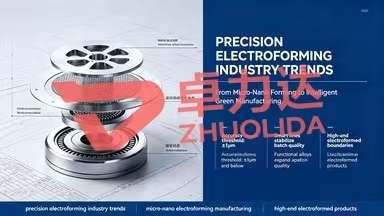
The application scenarios of precision electroforming technology are constantly expanding, breaking through the limitation of traditional electronic manufacturing fields. In the next five years, emerging high-end fields such as aerospace equipment, quantum communication devices, intelligent wearable devices, minimally invasive medical equipment and new energy energy storage will become new growth engines for the electroforming industry. High-precision aerospace micro filter components, medical anti-corrosion micro filter sheets, new energy ultra-thin conductive nickel sheets and precision fluid control parts show a year-on-year growing market demand. These products feature complex microstructures, ultra-high precision standards and harsh working environments, which continuously drive the iterative upgrading of electroforming processes and bring sustained and stable new growth space for the industry.
Domesticelectroforming technology, precision production equipment and standardized quality control systems have achieved rapid maturity in recent years, realizing comprehensive independent substitution of imported high-end micro-nano electroformed parts. The industry competition logic has completely changed from low-price vicious competition to value competition centered on technical strength, product stability and customized service capabilities. As a leading domestic precision electroforming manufacturer, Zhuolida continuously optimizes pulse electroforming technology and nano-precision molding processes. It stably supplies high-quality products including high-precision electroforming stencils, optical gratings, micro-hole filter meshes and ultra-thin special-shaped electroformed components, effectively promoting the high-end, standardized and intelligent development of the domestic electroforming industry.
Overall, from 2026 to 2030, the precision electroforming industry will present five major development directions: nano-level precision iteration, intelligent whole-process production, functional material customization, green low-carbon manufacturing and diversified scenario application. Low-end homogeneous backward production capacity will be continuously eliminated, and high-precision, high-stability customized electroformed products will occupy the mainstream market share. For downstream manufacturing enterprises, choosing professional and reliable domestic electroforming manufacturers can effectively stabilize the supply chain, control comprehensive production costs and significantly enhance the core market competitiveness of terminal precision products.

 189-3869-3452 0513-8160 1666
 E-MAIL:yw5@zldsmt.com
 QQ:$qq
 No. 268, Jinchuan Road, Nantong high tech Industrial Development Zone, Tongzhou District, Nantong City, Jiangsu Province
All Rights Reserved © 2019-2030Nantong Zhuolida metal Technology Co., Ltd.
ICP:【苏ICP备17060045号-3】


 TEL
TEL Products
 News
News About us